
Company stores
One place to order.
One version of your brand.
When a dozen teams are all buying branded gear on their own deadlines, you end up with a dozen versions of your brand. A company store gives everyone one place to order, with approved artwork and set pricing — so the on-brand choice is also the easy one.
Why a store
The problem is rarely the merchandise.
One department has a school screening. Recruiting has a career fair. Corporate events has a donor evening. Each one is real, each one has a date, and each one gets solved alone.
By the time anyone sees the whole picture, four versions of the logo are in circulation and no one can total a year of spend.
Brand standards do not fail because people ignore them. They fail because the wrong logo file is the one already sitting on somebody’s desktop, three days before an event.
So the job is not a better product. It is making the correct order the easiest one to place — and that is what a store is for.
Sometimes the right recommendation is not a product at all.
What you get
What a store actually changes.
- Approved artwork, locked in. Every item carries the current logo files at the right size and placement. There is no off-brand option left to choose.
- A set price on every item. Departments see the real number before they order, and finance can finally total a year of merchandise spend.
- Catalogs by department. Recruiting, events, and individual teams each start from the products that make sense for their work, not from everything at once.
- Ordering without the approval chase. A team with a deadline starts from a catalog instead of a phone call, and nobody is forwarding logo files over email.
- The unglamorous part, handled. Artwork, proofs, samples, production, shipping, and delivery stay ours to manage — the same as any other EYB project.
- A consultant who stays after launch. When a new initiative turns up with three weeks of notice and has to look like it belongs, someone already knows the standard.
How we build one
Built around your teams,
not around a template.
There is no consultation fee and no setup charge for the thinking. You pay for the merchandise your teams decide to order.
- Step 01
We start with who is actually buying
Before a single product goes in, we map the teams placing orders today, what each one buys, and the deadlines they are working against.
That is usually the first time anyone has seen the whole picture in one place — and it decides almost everything about how the store is built.
- Step 02
We curate the assortment
A store works because it is edited. We recommend a focused set of apparel, drinkware, gifts, and kit pieces that suit the people ordering and the budgets they have.
Fewer, better options mean less second-guessing and a store that still looks intentional a year in.
We buy from more than 3,000 suppliers, including the retail brands your team would pick for themselves.
- Step 03
We lock the brand in
Approved artwork, colors, decoration methods, and pricing are set once and applied to every item in the store.
From that point on, the correct order is the easiest one to place — which is the only version of brand standards that survives a busy quarter.
- Step 04
We keep it running
Stores are not a launch, they are a program. We add items for new initiatives, refresh what has gone stale, keep artwork current as the brand moves, and stay reachable when something is urgent.
Proof
Dozens of departments,
one brand standard.
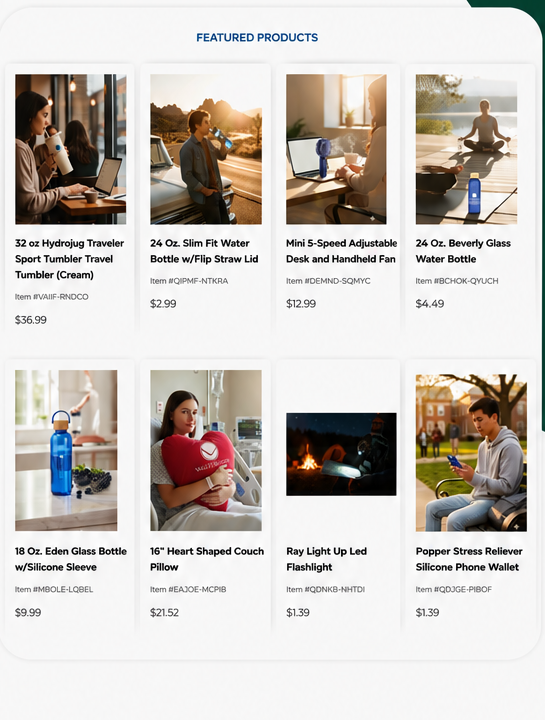
A Valley Health store split into catalogs by department, with approved artwork locked in and a set price on every item. There is no longer an off-brand option to choose, and a department with a deadline starts from a catalog instead of a phone call.
Is a store right for you?
Three signs it is time.
- 01
Several teams are ordering on their own.
Each one has a real date and solves it alone. Individually that is reasonable; together it is a brand problem nobody chose.
- 02
There is more than one version of your logo out there.
Standards do not fail because people ignore them. They fail because the wrong file is the one already on someone’s desktop.
- 03
Nobody can total last year’s spend.
When merchandise is bought in a dozen places, there is no line to point at — and no way to plan the next year against it.
What goes in
The kinds of things teams order.
- Branded apparel
- Outerwear
- Drinkware
- New hire kits
- Recognition awards
- Event giveaways
- Trade show kits
- Department-specific gear
- Client gifts
- Retail brands
A simple way to start